| Availability: | |
|---|---|
| Quantity: | |
simplex
NEWSUN
01
Characteristics:
The tight buffer fibre is easy to strip.
It exhibits excellent flame-retardant properties.
The simplex fiber optic cable, reinforced with aramid yarn as a strength member, possesses outstanding tensile strength.
The outer jacket material offers multiple benefits, including corrosion resistance, water resistance, UV radiation resistance, flame retardancy, and environmental friendliness.
Making Patch Cords or Pigtails: This cable can be used to create patch cords or pigtails for connecting fiber optic equipment.
Indoor Distribution: It is suitable for indoor fiber optic distribution systems, providing reliable connectivity within buildings.
Interconnect Between Instruments, Communication Equipments: This cable can be used to interconnect various instruments and communication equipment, ensuring high-speed data transmission.
The cable meets various international standards, including:
YD/T 1258.2: A Chinese standard for fiber optic cables.
ICEA-596: A standard by the Insulated Cable Engineers Association (ICEA) for fiber optic cables.
GR-409: A standard by Telcordia (formerly Bellcore) for fiber optic cable and splicing specifications.
IEC 60794-2-10/11: International Electrotechnical Commission (IEC) standards for optical fiber cables.
Additionally, the cable offers products that have passed specific certifications:
ULOFNR and OFNP Certifications: These are fire safety certifications indicating that the cable meets specific flammability requirements.
LSZH (Low Smoke Zero Halogen) Products: These cables use materials that produce low smoke and no halogen when burned, meeting fire safety standards such as IEC60332-1, IEC60332-3C, or OFNR certifications.
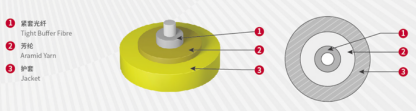
1.Tight Buffer Fibre
2.Aramid Yarn
3.Jacket

Characteristics:
The tight buffer fibre is easy to strip.
It exhibits excellent flame-retardant properties.
The simplex fiber optic cable, reinforced with aramid yarn as a strength member, possesses outstanding tensile strength.
The outer jacket material offers multiple benefits, including corrosion resistance, water resistance, UV radiation resistance, flame retardancy, and environmental friendliness.
Making Patch Cords or Pigtails: This cable can be used to create patch cords or pigtails for connecting fiber optic equipment.
Indoor Distribution: It is suitable for indoor fiber optic distribution systems, providing reliable connectivity within buildings.
Interconnect Between Instruments, Communication Equipments: This cable can be used to interconnect various instruments and communication equipment, ensuring high-speed data transmission.
The cable meets various international standards, including:
YD/T 1258.2: A Chinese standard for fiber optic cables.
ICEA-596: A standard by the Insulated Cable Engineers Association (ICEA) for fiber optic cables.
GR-409: A standard by Telcordia (formerly Bellcore) for fiber optic cable and splicing specifications.
IEC 60794-2-10/11: International Electrotechnical Commission (IEC) standards for optical fiber cables.
Additionally, the cable offers products that have passed specific certifications:
ULOFNR and OFNP Certifications: These are fire safety certifications indicating that the cable meets specific flammability requirements.
LSZH (Low Smoke Zero Halogen) Products: These cables use materials that produce low smoke and no halogen when burned, meeting fire safety standards such as IEC60332-1, IEC60332-3C, or OFNR certifications.
1.Tight Buffer Fibre
2.Aramid Yarn
3.Jacket

Cable Model | Cable Diameter (Ref) (mm) | Cable Weight (Ref) (kg/km) | TBF Diameter (µm) | Tensile Strenght Long/Short Term (N) | Crush Resistance Long/Short Term (N/100mm) | Bending Radius Dynamic/Static (mm) | |
PVC Jacket | LSZH Jacket | ||||||
1.6 | 1.6±0.2 | 2.4 | 2.6 | 600±50 | 40/80 | 100/500 | 60/30 |
1.9 | 1.9±0.2 | 3.5 | 4.5 | 900±50 | 60/100 | 100/500 | 60/30 |
2.8 | 2.8±0.2 | 6.0 | 7.5 | 900±50 | 60/100 | 100/500 | 60/30 |
Fiber Type | Attenuation | OFL | Effective Mode Bandwidth | 10 Gbit/s Ethernet Link Length | Minimum Bend Radius | |||
Condition | 1310/1550nm | 850/1300nm | 850/1300nm | 850nm | 850nm | / | ||
Typical Value | Maximum Value | Typical Value | Maximum Value | |||||
Unit | dB/km | dB/km | dB/km | dB/km | MHZ.km | MHZ.km | m | mm |
G652D | 0.36/0.22 | 0.5/0.4 | --- | --- | --- | --- | --- | 16 |
G657A1 | 0.36/0.22 | 0.5/0.4 | --- | --- | --- | --- | --- | 10 |
G657A2 | 0.36/0.22 | 0.5/0.4 | --- | --- | --- | --- | --- | 7.5 |
50/125 | --- | --- | 3.0/1.0 | 3.5/1.5 | ≥500/500 | --- | --- | 30 |
62.5/125 | --- | --- | 3.0/1.0 | 3.5/1.5 | ≥200/500 | --- | --- | 30 |
OM3 | --- | --- | 3.0/1.0 | 3.5/1.5 | ≥1500/500 | ≥2000 | ≤300 | 30 |
OM4 | --- | --- | 3.0/1.0 | 3.5/1.5 | ≥3500/500 | ≥4700 | ≤550 | 30 |
Cable Model | Cable Diameter (Ref) (mm) | Cable Weight (Ref) (kg/km) | TBF Diameter (µm) | Tensile Strenght Long/Short Term (N) | Crush Resistance Long/Short Term (N/100mm) | Bending Radius Dynamic/Static (mm) | |
PVC Jacket | LSZH Jacket | ||||||
1.6 | 1.6±0.2 | 2.4 | 2.6 | 600±50 | 40/80 | 100/500 | 60/30 |
1.9 | 1.9±0.2 | 3.5 | 4.5 | 900±50 | 60/100 | 100/500 | 60/30 |
2.8 | 2.8±0.2 | 6.0 | 7.5 | 900±50 | 60/100 | 100/500 | 60/30 |
Fiber Type | Attenuation | OFL | Effective Mode Bandwidth | 10 Gbit/s Ethernet Link Length | Minimum Bend Radius | |||
Condition | 1310/1550nm | 850/1300nm | 850/1300nm | 850nm | 850nm | / | ||
Typical Value | Maximum Value | Typical Value | Maximum Value | |||||
Unit | dB/km | dB/km | dB/km | dB/km | MHZ.km | MHZ.km | m | mm |
G652D | 0.36/0.22 | 0.5/0.4 | --- | --- | --- | --- | --- | 16 |
G657A1 | 0.36/0.22 | 0.5/0.4 | --- | --- | --- | --- | --- | 10 |
G657A2 | 0.36/0.22 | 0.5/0.4 | --- | --- | --- | --- | --- | 7.5 |
50/125 | --- | --- | 3.0/1.0 | 3.5/1.5 | ≥500/500 | --- | --- | 30 |
62.5/125 | --- | --- | 3.0/1.0 | 3.5/1.5 | ≥200/500 | --- | --- | 30 |
OM3 | --- | --- | 3.0/1.0 | 3.5/1.5 | ≥1500/500 | ≥2000 | ≤300 | 30 |
OM4 | --- | --- | 3.0/1.0 | 3.5/1.5 | ≥3500/500 | ≥4700 | ≤550 | 30 |