loading


| Availability: | |
|---|---|
| Quantity: | |
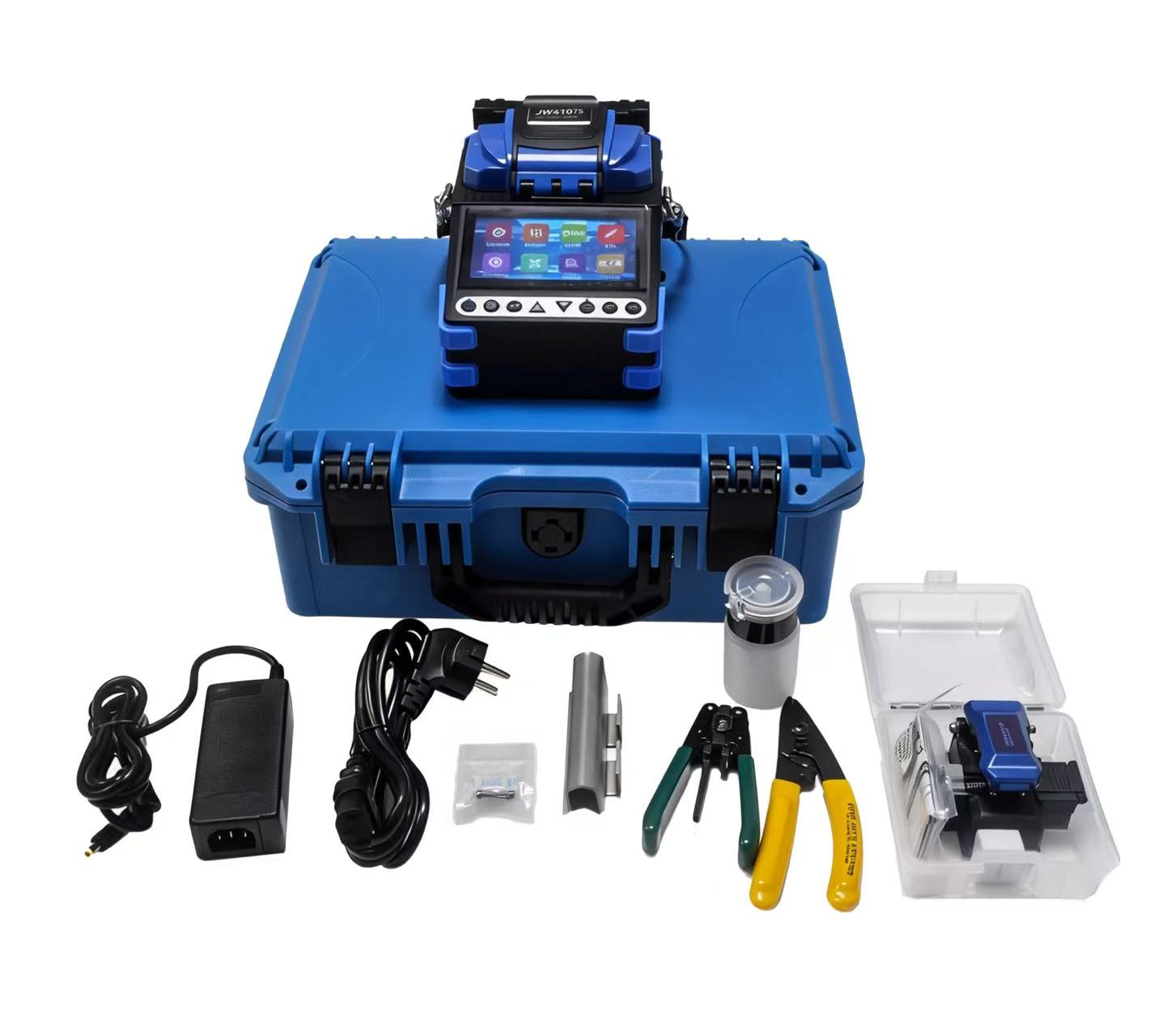
JW4107S
Newsun tech
3-in-1 Universal Fixture: Works with single-mode/multi-mode fibers, multi-core optical cables, bare fibers, tail fibers, jumpers, and patch cords for versatile compatibility.
Ultra-Fast Welding & Heating: Completes fusion splicing in just 5 seconds and finishes heating in 15 seconds, with an ultra-low splice loss as low as 0.02 dB (SMF).
Built-in OPM & VFL: Integrated optical power meter (supports 10 wavelengths, with self-calibration) and red light source for quick fiber testing and fault location.
4-Motor Automatic Focusing: Ensures precise alignment and consistent, reliable splicing results.
4.3" HD Touch Screen: Intuitive GUI interface with fast response, delivering smooth and convenient operation.
Large-Capacity Battery: 3000mAh lithium battery supports up to 240 cycles of splicing and heating on a single charge, with a USB interface for data export.
Durable & Practical Design: Equipped with LED lighting for dark environments; stores up to 3000 sets of splicing records and 200 images for traceability.
Fiber Compatibility: Supports SMF (G.652), MMF (G.651), DSF (G.653), NZDSF (G.655)
Electrode Lifespan: Up to 3000 splices
Working Conditions: Operates reliably in temperatures from -10℃ to 50℃, humidity ≤95%, and wind speeds ≤15m/s
Portable Build: Compact, lightweight design (1.3kg) with rugged construction for field use
| Item | Specification |
|---|---|
| Electrode life | 3000 times |
| Charging time | ≤3 hours |
| Battery capacity | 3000mAh |
| Input voltage | DC13-14V |
| Charging input | AC100-240V、50/60Hz |
| Welding mode | Auto/Manual |
| Weight/Size | 1.3Kg / 217mm × 115mm × 115mm |
| Working environment | Working temperature: -10~50℃; Humidity: ≤95%; Wind speed: ≤15m/s |
| Storage conditions | Storage temperature: -40~60℃; Humidity: ≤95% |
| Item | Specification |
|---|---|
| Optical fiber | SMF(G.652)/MMF(G.651)/DSF(G.653)/NZDSF(G.655) |
| Fiber Diameter | cladding:80-150um; Coating:0.1-3mm |
| Splice loss | 0.02dB(SMF)/0.02dB(MMF)/0.05dB(DSF/NZDSF) |
| Alignment method | Fiber core, cladding |
| Focusing | Four motor automatic focusing |
| Sealing | Automatic/semi-automatic/manual |
| Weld time | 5 seconds (SMF typical value) |
| Return loss | ≥60dB |
| Image display | 4.3-inch high-definition touch LCD screen |
| Welding record | 3000 sets of data and 200 images |
| Heating time | 15S (time optional) |
| Heating time | 0-90S |
| Heat shrink tubing | 20mm/30mm/40mm/50mm/60mm |
| Operation interface | GUI graphical user interface |
Optical fiber fusion splicing is a welded joint formed between two optical fibers. Fusion splicing is a permanent, low-loss, high-strength joint compared with other temporary joint such as a mechanical splice. Optical fiber fusion splices play a crucial role in the optical network.
Fusion splicing is very compact;
Fusion splicing has the lowest insertion loss;
Fusion splicing has the lowest back reflection (optical return loss ORL);
Fusion splicing has the highest mechanical strength;
Fusion splicing is permanent;
Fusion splicing can withstand extreme high temperature changes;
Fusion splicing prevents dust and other contaminants from entering the optical path;
Fusion splicers can be subjected to reinforcement treatment efficiently within a proper timing by keeping track of the reinforcement treatment progress state to perform fusion splice and reinforcement treatment in parallel with each other which is beneficial.
By use of it, it has become possible to track of the progress and the progress state of the current reinforcement treatment being executed in real time on the display for monitoring the state of fusion splice, so that fusion splice and preparations for reinforcement treatment of the optical fibers are to be next subjected to reinforcement treatment can be executed at good timing.
In Fusion splicing, it basically includes welding,so no air-gap exist with, as compared to mechanical splicing, where air gap does exist. Splicing machine price in India can be checked online.
Fusion splicing can costs more beforehand due to the investment that is required to add a fusion splicing machine into your set of tools but however,it offers a lower variable cost per fusion splice which makes it reasonable.
The method of fusion splicing provides an intricate connection between two fibers which offers a lower insertion loss and better performance when compared to mechanical splicing.
Fusion splicing also produces a transparent, non-reflective and continuous connection between the fibers that has helped in enabling very low loss light transmission and makes the connection more efficient and reliable.
Optical fiber stripping;
Fiber cleaving;
Fiber alignment;
Fiber welding;
Insertion loss estimation;
Pull tension strength testing;
Splice protection with fusion splice sleeve;
Fiber splicing is the process of permanently joining two fibers together. Unlike fiber connectors, which are designed for easy reconfiguration on cross-connect or patch panels. Fusion splicer is the machine used to weld (fuse) two optical fibers together. This process is called fusion splicing. The fiber ends are prepared, cleaved, and placed in alignment fixtures on the fusion splicer. At the press of a button, the fiber ends are heated with electrodes, brought together, and fused.
 Certificate of Conformity |
|  Certification for Sale Transport |
 ISO 9001 |  SGS |
Patent Certificate |

Copyright © 2026 NEWSUN All Rights Reserved.


 Quality Management System


